All posts tagged: sustainability

Berlin to Copenhagen

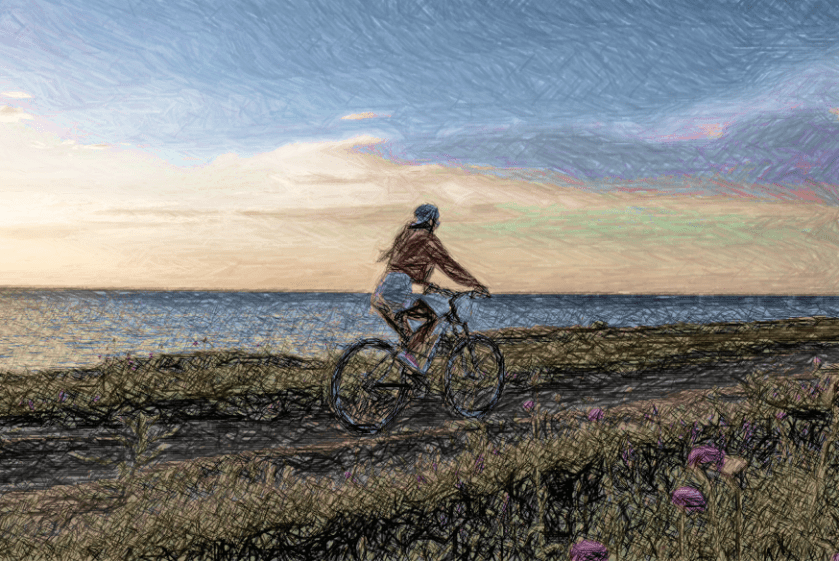
Between a cozy Kneipe in Berlin and a hyggelig hotel lounge in Copenhagen, a seasoned cyclist travels along the Berlin to Copenhagen Bicycle Route, completing the journey in under a week. We may not all strive to be seasoned cyclists, but if you appreciate European capitals and cultural experiences; love national parks and being in nature; resonate with environmentally friendly vacations and exploring something new: here’s your sign. As post-pandemic travel surged, so have accounts of the escalating costs, declining quality, long lines and delays, and misadventures at airports and aboard cramped flights. The phrase “travel isn’t fun anymore” has become like a punctuation mark at the end of dispiriting narratives. To reclaim the vitality of traveling, let us reclaim the journey itself. It is not only about a destination; it is also the way that we lean into: the places we travel through, mindful and flexible, at a human pace — and the people, nature, and cultural expressions we observe and interact with along the way. It is about what emerges from within — when given the …
Biome sweet biome

Where do you live?  If you were asked this question while away from home, you probably would mention your city or state. If abroad, you would likely mention your nationality or the country in which you live. If you encounter someone from your own city or town, you might talk about your neighborhood, your Kiez or quartier — maybe even your street or building. Where do you really live? Something has been missing from the framework: a piece that references our interconnection with nature. Your biome. If you do not know about your biome, you are not alone. We could all improve our ecoliteracy. Ecoliteracy – “knowledge of the environment necessary for informed decision-making”. Biome – “a community of plants and animals living together in a certain kind of climate”, also known as a bioclimatic landscape. Do you share yours with foxes, bison, wolves, hedgehogs, otters, wrens, spruce, beech trees? Black bears, raccoons, great horned owls, quaking aspens? Water buffalo, i’iwi, geckos, monkey beetles, snow leopards, bridled nail-tail wallabies, tortoises, Atlantic puffins, monarch butterflies, pine oaks? There are countless ways …

Sustainable. But have you ever been to Baden-Württemberg?

What makes a building a green building? Green buildings are designed with sustainability goals and fulfill specific criteria in their construction, maintenance, and life cycle — designated by certifications such as LEED® (Leadership in Energy and Environmental Design) from the U.S. Green Building Council or the DGNB System (Deutsches Gesellschaft für Nachhaltiges Bauen) from the German Sustainable Building Council. For those looking for entry points and a general understanding of how a building is actually a sustainable building though, it helps to consider models and look at details.  “The most sustainable building in the world” Earning a platinum certificate with the highest DGNB certification score achieved thus far, the building known as the Eisbärhaus (Polar Bear House) in Baden-Württemberg, Germany proffers many mindful details. These include: building material choices, such as using recycled concrete in the reinforced concrete-wood hybrid structure; energy efficiency solutions, such as a battery storage system for storing the electricity generated by a photovoltaic system — to use when needed; and a software system, which controls various features in response to current local weather conditions — and …

Survival of the Most Adaptable

The German Sustainability Award, sponsored by the Federal Government of Germany, is the most comprehensive environmental award in Europe. Competition is focused in eight categories: architecture, companies, corporate partnerships, design, municipalities, NEA (next economy award), packaging, and research. Research plays a significant role in all areas but merits its own category. A rich potentiality thrives in research and yet it can be daunting, as new ideas are cooled in theoretical frameworks, pooling deep in scientific journals and libraries—instead of focused, like a laser-beam, towards generating new dimensional realities. How do we shift into applied research (pivoting away from what Greta Thunberg recently called the “blah, blah, blah” of politicians’ speeches) and turn the knowledge available to us into solutions and action—baby steps, if that’s what will get us started—immediately? First, we recognize where we are. The leitmotif in the research category this year is adaptation — adaptation to climate change and extreme weather events. In western Europe, as in other regions of the world, the extreme rainfall, flash floods, and intense heatwaves in recent years have made it clear that …

Architectural Quality and Culture: Practically Perfect

Is a utopia the opposite of a dystopia? Dystopia refers to “an imagined state or society in which there is great suffering or injustice, typically one that is totalitarian or post-apocalyptic.” (New Oxford American Dictionary). Utopia calls to mind an ideal place – with all the desirable qualities for a wholesome human society.  Sir Thomas More introduced the term in his 1516 novel Utopia, about a fictional island society. And while that society was located in the south Atlantic Ocean, the word utopia translates from the Greek into English as “no-place”.  So actually, a “utopia” is, in its very code, a promise of perfection with an underlying belief that such a place cannot exist in the real world. Dystopia often calls to mind George Orwell’s Nineteen Eighty-Four. But since that novel was published in 1949, dystopian science fiction stories and films have inundated the mainstream. Think of the stories that can be described as “utopian” – how many can you call to mind? Of course, an emphasis on dystopian patterns must have shaped the way that generations of people in western societies have consciously and unconsciously perceived …